


Editorial Policy of the Journal
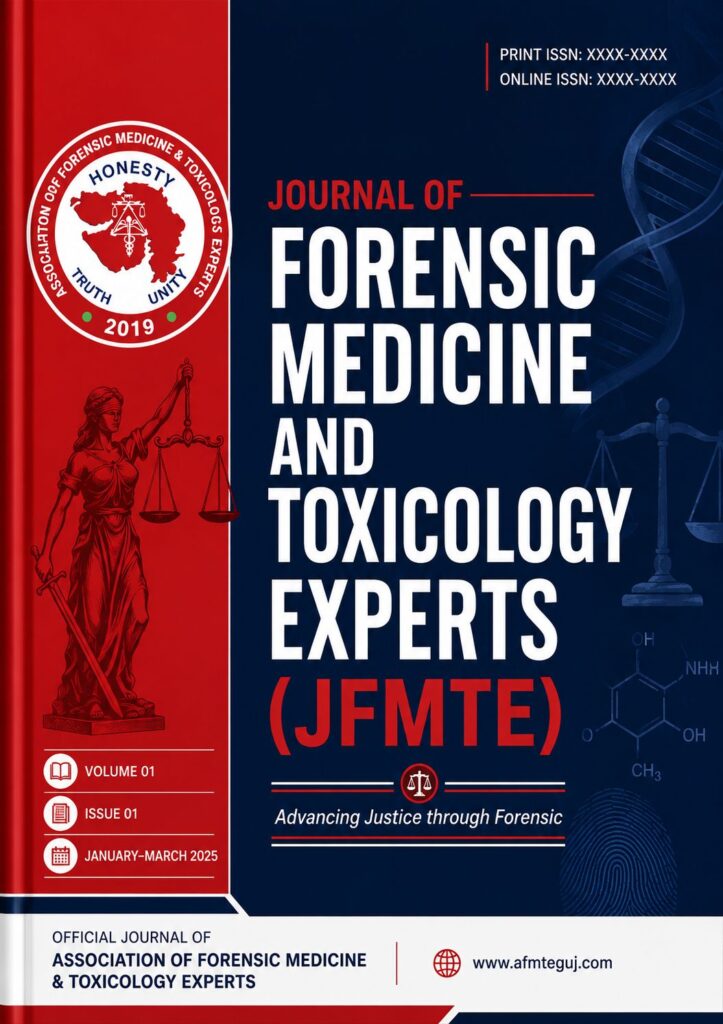
The JOURNAL OF FORENSIC MEDICINE AND TOXICOLOGY EXPERTS (JFMTE) is committed to maintaining the highest standards of scientific integrity, academic excellence, ethical publication practices, and editorial transparency. The journal follows a rigorous editorial process to ensure the publication of scientifically sound, original, relevant, and ethically conducted scholarly work in the fields of forensic medicine, toxicology, medico-legal sciences, forensic pathology, and allied disciplines.
JFMTE adheres to internationally accepted publication standards and editorial principles to ensure quality, fairness, transparency, and integrity throughout the manuscript evaluation and publication process.
Editorial Independence
The editorial decisions of JFMTE are made independently by the Editorial Board based solely on the scientific merit, originality, methodological quality, ethical standards, and relevance of submitted manuscripts. Editorial decisions are free from commercial, institutional, financial, or personal influence.
The Editor-in-Chief and Editorial Board reserve the right to accept, reject, or request revisions for submitted manuscripts based on peer reviewer comments and editorial assessment.
Manuscript Screening Process
All submitted manuscripts undergo an initial editorial screening before being sent for peer review. During this stage, manuscripts are assessed for:
- Relevance to the journal scope
- Originality and scientific merit
- Adherence to author guidelines
- Ethical approval requirements
- Plagiarism and similarity assessment
- Completeness of documentation
- Formatting and language quality
The Editorial Office may return manuscripts to authors for technical modifications prior to peer review.
Peer Review Policy
JFMTE follows a double-blind peer review system, wherein the identities of both authors and reviewers remain confidential throughout the review process.
Each manuscript is generally evaluated by two or more independent expert reviewers possessing relevant expertise in the subject area.
The peer review process evaluates manuscripts based on:
- Scientific validity
- Methodological rigor
- Ethical compliance
- Statistical appropriateness
- Clinical and medico-legal relevance
- Originality and novelty
- Quality of interpretation and discussion
Based on reviewer comments and editorial evaluation, manuscripts may receive one of the following decisions:
- Accept without revision
- Minor revision required
- Major revision required
- Resubmission for review
- Rejection
The final decision regarding publication rests solely with the Editor-in-Chief.
Confidentiality of Submitted Manuscripts
All manuscripts submitted to JFMTE are treated as confidential documents. Editorial staff, reviewers, and editorial board members are required to maintain confidentiality and may not disclose or use unpublished information for personal or professional gain.
Reviewers are prohibited from sharing manuscript contents or discussing submissions with unauthorized individuals.
Plagiarism Screening
JFMTE maintains a strict anti-plagiarism policy. All manuscripts undergo plagiarism screening with recognised similarity-detection software before peer review.
Manuscripts found to contain:
- Plagiarism
- Self-plagiarism
- Redundant publication
- Duplicate submission
- Fabricated or falsified data
may be rejected immediately.
The Editorial Board shall determine the acceptable similarity threshold in accordance with international ethical publication standards.
Ethical Approval Requirements
Research involving human participants, medico-legal subjects, biological specimens, or patient-related information must comply with accepted ethical standards.
Authors must provide:
- Institutional Ethics Committee approval details
- Informed consent, where applicable
- Compliance with ethical regulations and institutional policies
Studies involving postmortem research, forensic specimens, medico-legal documentation, or vulnerable populations must demonstrate appropriate ethical safeguards.
Authorship Criteria
JFMTE follows the authorship recommendations established by the International Committee of Medical Journal Editors (ICMJE).
Authorship shall be limited to individuals who have made substantial contributions to:
- Conception or design of the study, or acquisition/analysis/interpretation of data
- Drafting or critical revision of the manuscript
- Approval of the final manuscript version
- Accountability for the integrity and accuracy of the work
Individuals not meeting authorship criteria should be acknowledged appropriately.
Conflict of Interest Policy
Authors, reviewers, and editors are required to disclose any financial, institutional, academic, or personal conflicts of interest that may influence the research or editorial process.
Any disclosed conflicts shall be evaluated by the Editorial Board and may be published where deemed necessary in the interest of transparency.
Artificial Intelligence (AI) Policy
The use of Artificial Intelligence (AI) tools for language enhancement, grammar improvement, or formatting assistance must be disclosed by authors at the time of manuscript submission.
AI tools shall not be listed as authors.
Authors remain fully responsible for:
- Scientific accuracy
- Data integrity
- Ethical compliance
- Interpretation of findings
- Originality of content
Undisclosed or inappropriate use of AI-generated scientific content may lead to manuscript rejection.
Corrections, Retractions, and Editorial Expressions of Concern
JFMTE is committed to maintaining the integrity of the scientific record.
The journal may issue:
Corrections (Erratum/Corrigendum)
For minor factual or typographical errors not affecting scientific validity.
Retractions
In cases involving:
- Scientific misconduct
- Data fabrication or falsification
- Ethical violations
- Serious plagiarism
- Duplicate publication
Editorial Expressions of Concern
When serious concerns arise pending formal investigation.
Retraction and correction decisions shall be made in accordance with accepted publication ethics guidelines.
Appeals and Complaints
Authors may appeal editorial decisions by submitting a written explanation to the Editorial Office. Appeals shall undergo independent editorial evaluation and may include reassessment by additional reviewers where necessary.
The Editor-in-Chief reserves the final authority regarding disputed editorial decisions.
Publication Timeline
JFMTE strives to ensure a fair and timely editorial process.
Estimated Timeline:
- Initial Editorial Screening: [To be Updated]
- Peer Review Duration: [To be Updated]
- Revision Period: [To be Updated]
- Final Decision: [To be Updated]
- Online/Print Publication: [To be Updated]
Publication timelines may vary depending on reviewer availability and manuscript revisions.
Editorial Responsibility
The Editorial Board of JFMTE is committed to:
- Maintaining scientific quality
- Ensuring impartial editorial decisions
- Preserving reviewer confidentiality
- Promoting ethical publication practices
- Preventing scientific misconduct
- Encouraging high-quality forensic and toxicological research